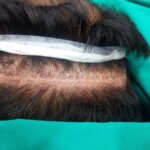

DHI (direct hair implantation) is a variation of FUE hair transplant. Grafts are extracted one by one in the same way, but they are implanted with a pen-like device, often called a Choi implanter, which makes the opening and places the graft in a single movement. This gives the team close control over angle and direction and can be useful for hairlines and for adding density between existing hairs. It is not a different kind of surgery, and results still depend mainly on the skill of the team.
How DHI works
The steps are almost the same as standard FUE until implantation:
- Consultation and design of the hairline and zones to treat.
- Local anaesthetic in the donor and recipient areas.
- Extraction of follicular units from the back and sides of the scalp with a small punch.
- Loading each graft into the hollow needle of an implanter pen.
- Implantation: the pen is pushed into the scalp at the chosen angle and depth, and the graft is released as the needle is withdrawn.
In classic FUE, the surgeon first makes all the recipient incisions with a blade or needle, then grafts are placed into them with forceps. DHI combines those two steps.
DHI versus FUE at a glance
| Aspect | Classic FUE | DHI (implanter pen) |
|---|---|---|
| Extraction | Individual units with a punch | Same |
| Recipient sites | Made in advance with blade or needle | Made at the moment of implanting |
| Implantation tool | Forceps | Implanter pen |
| Shaving | Donor shaved; recipient often shaved | Donor usually shaved; recipient may be left unshaved in some cases |
| Speed | Often faster for large sessions | Can be slower, needs more staff and pens |
| Typical use | Large areas, high graft numbers | Hairlines, density between existing hair, smaller areas |
Some clinics combine both methods in one procedure, using DHI for the hairline and classic FUE behind it. Our guide to FUE hair transplant in Dubai covers the standard method in detail.
Claimed advantages and what to make of them
Clinics often highlight these points for DHI:
- Control of angle and direction. The pen sets both at the moment of implantation, which can help create a natural hairline.
- Less handling of grafts. Grafts are loaded into the pen rather than squeezed with forceps into a pre-made slit.
- Working between existing hairs. Making each opening at implantation can reduce damage to nearby native hair, which helps when adding density to thinning areas.
- Possible unshaven recipient area, useful for people who cannot take time off. See hair transplant without shaving.
Comparative studies between DHI and FUE are limited, and published results depend heavily on the team. Skilled surgeons achieve excellent results with both. Be cautious of any clinic that claims one method guarantees better growth.
The method name matters less than who designs the hairline and who places the grafts.
Limitations
- Time and staffing: pens must be loaded continuously, so large cases need more trained staff or more time.
- Cost: DHI is commonly priced higher than standard FUE.
- Not ideal for every case: very large bald areas may be done more efficiently with classic FUE, or a combination.
- Donor limits are the same: DHI does not create extra donor hair. Your graft supply is unchanged. Use our graft count estimator for a rough sense of numbers.
Who might be a good candidate
DHI is commonly chosen for:
- Hairline restoration where precision matters.
- Adding density between existing hairs in early to moderate thinning.
- Smaller areas, such as temples or a single zone.
- Eyebrow and beard work, depending on the clinic.
As with any transplant, candidates should have stable, diagnosed pattern hair loss and enough donor hair. Many surgeons advise treating ongoing loss with medication first so the transplanted area does not end up as an island. Our hair loss stages guide helps describe where you are.
Recovery
Recovery is very similar to FUE:
Typical recovery timeline
- Days 1 to 3: redness, mild swelling, tiny crusts.
- Days 7 to 14: crusts come away with careful washing.
- Weeks 2 to 8: transplanted hairs commonly shed.
- Months 3 to 4: new growth begins.
- Months 9 to 12: most of the final result is visible.
In the UAE, protect the scalp from direct sun and heavy sweating in the first weeks, avoid pools and the sea until cleared, and follow the clinic’s washing routine exactly.
Risks and red flags
Risks are the same as other FUE-type procedures: swelling, numbness, temporary shedding of native hair (shock loss), folliculitis, infection, poor growth and unnatural results if planning is poor.
Contact your clinic urgently if you notice
- Spreading redness, heat or pus.
- Fever or feeling unwell.
- Pain that increases after the first few days.
- Bleeding that does not stop with gentle pressure.
Choosing a DHI clinic in the UAE
Hair transplant is surgery, and in the UAE facilities and doctors must be licensed: by the DHA in Dubai, the DOH in Abu Dhabi, or MOHAP in the northern emirates. Ask:
- Which licensed surgeon performs or supervises each step?
- How many pens and staff are used, and how long will the procedure take?
- Is the whole procedure DHI, or a combination with FUE?
- How many grafts are planned and why?
- What follow-up appointments are included?
Prices vary widely across the UAE. Compare written quotes that state the graft count, method for each zone and who performs the work.
Frequently asked questions
Is DHI better than FUE?
Neither is universally better. DHI offers precise placement and can work well for hairlines and dense packing, while classic FUE can be more efficient for large areas. The team’s skill matters most.
Does DHI require shaving?
The donor area is usually shaved. Some clinics can implant into an unshaven recipient area for smaller cases. Ask what applies to you.
Is DHI painful?
It is done under local anaesthetic. The injections sting briefly; after that most people feel pressure rather than pain.
Why is DHI often more expensive?
It usually needs more trained staff, more instruments and more time per graft.
Sources: International Society of Hair Restoration Surgery, Dubai Health Authority, American Academy of Dermatology
Last reviewed: 2026-11-25. General information only, not medical advice. Please consult a licensed practitioner in the UAE about your own situation.