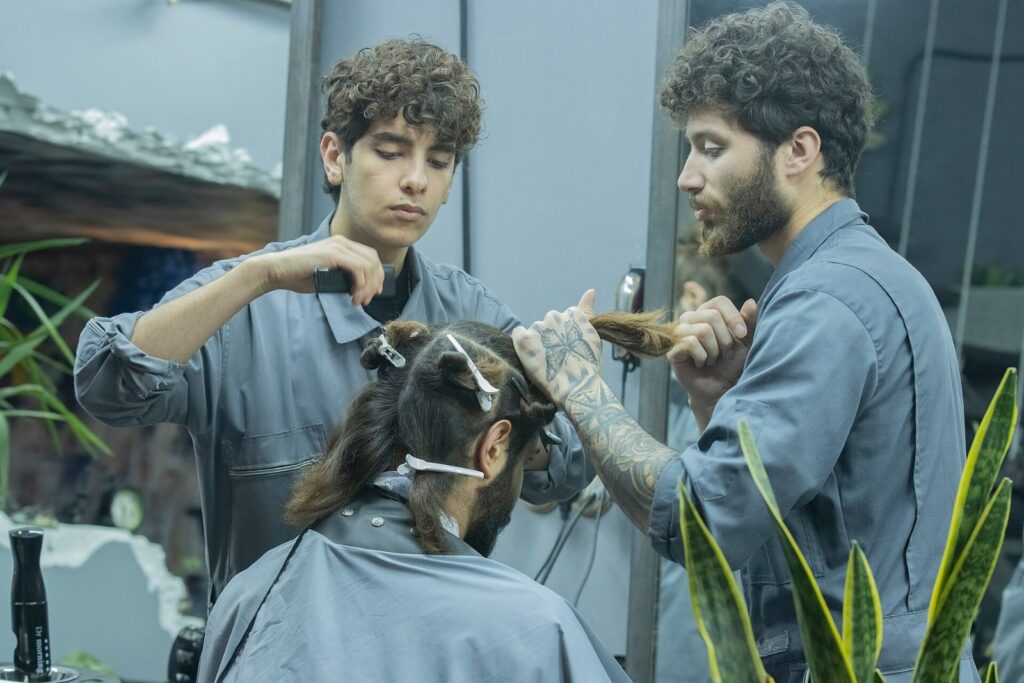

The safest way to remove most semi-permanent hair extensions, including tapes, keratin bonds, micro beads and sewn wefts, is to have a trained stylist do it with the right remover or tools. Clip-ins and halo pieces are easy to take out yourself. Pulling, cutting or picking at attachments is the most common cause of breakage at removal, so patience and the correct method matter more than speed.
In this guide
- Removal by method
- What a professional removal looks like
- Why DIY removal often goes wrong
- How much hair loss at removal is normal?
- Caring for your hair after removal
- Should you reinstall straight away?
- Removing clip-ins and halos the right way
- Reusing extension hair
- Planning removal and timing
- Frequently asked questions
Removal by method
| Extension type | How it is removed | DIY? |
|---|---|---|
| Clip-in | Open each clip and slide out gently | Yes |
| Halo or wire | Lift off over the head | Yes |
| Tape-in | Adhesive remover is applied, then tapes slide apart | Best done by a stylist |
| Keratin bond (fusion) | Solvent softens the bond, a tool crushes it, strand slides off | Stylist only |
| I-tip / micro bead | Pliers open each bead, strand slides out | Best done by a stylist |
| Sewn-in weft | Thread is carefully cut away from the braid, braid undone | Stylist recommended |
| Beaded weft | Beads opened row by row | Stylist recommended |
What a professional removal looks like
Tape-ins. The stylist applies an adhesive remover along the tape, waits for it to soften, then gently slides the wefts apart and off the hair. Any remaining residue is worked out with more remover and a fine comb. Your hair is then washed to remove the remaining product.
Keratin bonds. A bond remover is applied to each bond, then a small pliers-type tool crushes the bond so it breaks up. The extension strand is slid down and off, and residue is combed out. This takes time, especially for a full head.
Micro beads and I-tips. The stylist opens each bead with pliers, slides the strand out, and removes the bead. Hair that was in the bead is gently separated.
Sewn wefts. The thread holding the weft is cut carefully, away from your own hair, and the weft is lifted off. The supporting braid is then undone slowly from the ends up.

Why DIY removal often goes wrong
- Tapes pulled apart dry can rip out natural hair stuck in the adhesive.
- Bonds cut off with scissors often cut your own hair too, leaving short broken pieces.
- Beads forced open with the wrong tool can snap the hair inside.
- Rushing through matted areas tears hair rather than separating it.
If you must remove tape-ins at home, use a remover made for that brand of tape, follow its instructions exactly, and stop if hair is pulling. For bonds and beads, a stylist is strongly recommended.
How much hair loss at removal is normal?
Seeing a clump of loose hair when extensions come out often causes alarm. Some of it is normal. Everyone sheds hairs every day, and while extensions are in, many of these shed hairs stay trapped in the tape, bond or bead. When the attachment is removed, weeks of shedding come out at once.
Usually normal at removal
- Loose full-length hairs released from each attachment
- Some tangles that need gentle detangling
- Slight tenderness at the roots for a day or two
Not normal, see a dermatologist if you notice
- Bald patches, gaps or very thin areas where attachments sat
- Many short broken hairs at the root line
- A receding hairline at the temples or front
- Scalp redness, bumps, pus or pain that persists
These can indicate traction alopecia or infection. Traction hair loss can often recover if tension stops early, but long-term traction may cause permanent loss. Our hair loss stages guide can help you describe any thinning pattern to a doctor.
Caring for your hair after removal
The first few weeks
- Wash with a gentle shampoo and use conditioner on the lengths.
- Detangle slowly with a wide-tooth comb, starting at the ends.
- Avoid tight ponytails and buns while roots recover.
- Limit heat styling and chemical treatments for a while.
- Consider a trim to remove split or weakened ends.
- Protect hair and scalp from strong sun, chlorine and salt water.
In the UAE, many people choose to give their hair a break from extensions over the hottest months, when sweat and pool time make semi-permanent attachments harder to maintain. Clip-ins can provide volume for special occasions while your natural hair rests.
Should you reinstall straight away?
If your hair and scalp look healthy, many stylists will move up or reinstall extensions at the same appointment. If you notice thinning, tenderness, breakage or irritation, a break is wiser. Use the time to check whether your natural hair has changed. If you are not sure, ask a dermatologist before reinstalling.
Removal is the moment of truth for your natural hair. Take a good look before putting anything back in.
Removing clip-ins and halos the right way
Even temporary extensions can cause breakage if removed carelessly. For clip-ins, start at the top row and work down, opening each clip fully before sliding it out rather than tugging. Run your fingers through the section to make sure no hair is caught in the comb of the clip. For halo pieces, lift the wire up and back over the crown, and check that it has not tangled into your own hair at the nape.
Brush the extension pieces gently from the ends upward before storing them flat or hanging in a dry place, away from direct sun and humidity in the bathroom. Brush your own hair separately, and give your scalp a few clip-free days each week, especially if you wear clip-ins for long hours at work or events.
Reusing extension hair
Good-quality human hair can often be cleaned, re-taped or re-tipped and reused. Your stylist will check whether it is still smooth, tangle-free and strong enough. Synthetic hair is rarely worth reusing once it has frizzed or matted.
Planning removal and timing
Book removal before attachments grow too far from the scalp or begin to mat, since overdue extensions take longer to remove and cause more breakage. If you are travelling for a long period, plan removal before you leave rather than leaving extensions in for months without maintenance. Allow enough time at the salon, as a careful removal of a full head can take a while, and ask for removal and any reinstallation to be quoted together.
Frequently asked questions
Can I remove tape extensions with oil?
Some people use oil to loosen tape adhesive, but a remover designed for the tape works more reliably and is less likely to leave residue.
How long does professional removal take?
It depends on the method and number of attachments. Keratin bonds usually take longest.
Why is so much hair coming out when extensions are removed?
Hair you would normally have shed over several weeks was held by the attachments. It is released all at once.
How long should I wait before getting new extensions?
If your hair is healthy, you can reinstall straight away. If you notice thinning or irritation, take a break and get advice.
Sources: American Academy of Dermatology, British Association of Dermatologists, NHS
Last reviewed: 2026-11-25. General information only, not medical advice. Please consult a licensed practitioner in the UAE about your own situation.